Friday, August 27, 2021

Remembering Ken Bloomquist


The greatest influences on me as a percussionist are well known and previously written about in various essays and publications of mine over the years. Mark Johnson (as pictured with me and Ken Bloomquist) my teacher at Michigan State, Salvatore Rabbio, with whom (when I was an undergraduate) I studied timpani in the summers, and Thomas Siwe, my teacher at the University of Illinois. And, of course, I have fond memories of my career as a professional percussionist.

But some might regard my work as a conductor, specifically of the University of New Mexico Percussion Ensemble, as my greater legacy. And certainly there are many former students of mine out there in the world doing amazing things who were part of the deeply collaborative efforts behind the many great performances and recordings we made between 1980 and 1996, the year I stepped down as director of the ensemble. The collaboration however was of a very specific type and that had to do with my idea of what it means to be an ensemble director. And that was influenced not by my percussion teachers, nor by the many orchestral conductors I worked with between 1980 and 1994, but by two college band directors: Dr. Harry Begian, Director of Bands at the University of Illinois, and Professor Kenneth Bloomquist, Director of Bands at Michigan State University. I wrote a blog entry about Dr. Begian in 2014 after he passed away and now that Mr. Bloomquist has also passed, I want to add a complementary appreciation of him. 


Everything I cherish most about directing an ensemble I learned from these two legends of band history. My time with Dr. Begian was intense and focused, lasting for one academic year 1979-1980. Everyone has a “Begian story” as it were, and none of them are usually regarded as bright and cheery. He was taciturn and moody, an introverted perfectionist for whom nothing was really good enough, and if you ever got on his wrong side, well heaven help you. And yet I, like some others (but not everyone), loved him. For his musicianship first of all--he should have been conducting professional orchestras, not bands, for one thing. I studied conducting with him (my only formal training) and he was a demanding and exacting coach. I had only once lifted a baton in my life (a performance of Coat of Arms, my favorite march, at my graduation ceremony at MSU) and yet by the end of that year I was a reasonably accomplished conductor, certainly well enough trained to begin my duties as Director of Percussion Studies at UNM the following year.


Ken Bloomquist also studied at the University of Illinois and came to MSU from the University of Kansas, where he was first Professor of Trumpet. The best trumpet students at MSU often secretly studied with Bloomquist, in addition to their lessons with the trumpet professor there. And I hesitate here, part of the reason it has taken me awhile to write this remembrance. My experiences with Mr. Bloomquist (I never could really get used to addressing him as “Ken” even though he insisted once I started my teaching career) had a much deeper resonance with me and over a longer period of time. And after he passed away, a flood of memories came back to me from that time, some good and some bad. So I've taken some time to sort through those, to decide what to include and not include, and I’ve made the decision, at least in part because we live in an age of social media where many of the students I went to school with are active participants (including many Facebook friends), to limit those memories to positive things directly related to the enormous influence Mr. Bloomquist had on my early musical life. 


My father, who would have been eighty-six on the day I’ve begun writing this (August 25, 2021), was an MSU graduate and also a very fine percussionist, who played in both concert and marching bands under the direction of another band legend Leonard Falcone. Dr. Begian was his brief successor before leaving to take on the legendary band program at the University of Illinois and Mr. Bloomquist was his replacement. Dr. Begian was only the third director hired to head the Illinois band program and, if I’m not mistaken, Mr. Bloomquist would have been the third director hired to run the band program at MSU. For me, growing up in rural mid-Michigan, it was being in band that mattered, whether that be Summer Youth Music at Michigan State, a very important early influence on me as a young high school musician, or getting first chair in All State Band at Interlochen. I remember being disappointed when in my junior year I was the highest ranked percussionist for the Michigan Solo and Ensemble State competition (a score of 93 for Proficiency II, the solo I played was the four mallet movement “Sarabande” from William Kraft’s French Suite, my judge was Ken Snoeck, who was then teaching at Central Michigan University) and given the honor of being timpanist in the Honors Orchestra under the direction of another legend in that field, Dr. Marilyn Kesler, long-time orchestra conductor for Okemos High School (and who I just read got her start teaching music in Alton, Illinois where my mother and two brothers presently live). As a footnote it was a fantastic experience, Dr. Kesler was an amazing and inspiring conductor, and I can still remember playing timpani for Tchaikowsky’s Romeo and Juliet Fantasy Overture. What a great experience for a sixteen year old who had never played in an orchestra before. But still, my first reaction when I received word of my being selected was--I wanted to play in the band!


And band for me, thanks to my father, meant the MSU Bands, then under the direction of Ken Bloomquist. My band directors in Leslie, Michigan, the small town I grew up in were all great and with different backgrounds: Steven Baxter, a Western Michigan graduate; Steven Leeser a Michigan graduate (and from the famed Pennfield High School band program with whom I was lucky enough to work with as an MSU undergraduate during their summer marching band camps); and William Berz, an MSU graduate and friends with many MSU musicians who would still be in school when I arrived as a freshman in 1975. And there was never any doubt that was where I would go to school. I had received a scholarship at Interlochen to attend the University of Michigan (they ran the All-State program) and although my father was proud of that, after I auditioned for and received a scholarship to attend MSU, his response was: “you can go where you want but if you want any assistance from me, you’ll go to Michigan State.” In the end, I’m glad he insisted because Michigan State University had an amazing music program in the 1970s (still does) but back then, I don’t think anyone would disagree, for an instrumentalist MSU was a “band school.” And although I loved playing in orchestra with Dennis Burkh (I had heard the “h” was added by him for international effect), and even began playing timpani there before I did the same in bands, for me at least I didn’t arrive until I was first chair in the Symphonic Band which took a while but, as promised, no sad stories here. Except for one, and this is where my personal experience with, and appreciation for, Mr. Bloomquist is best expressed. 


Growing up, the best concert band sound was, for me, the Michigan State University Symphonic Band. Wind Ensembles were becoming increasingly the norm (first at Eastman, the University of Michigan under H. Robert Reynolds of course, although that came later) but in my formative years, let’s say 1971-1975, I loved the large ensemble sound. Dr. Begian was a famous proponent of that and there are many great recordings that preserve that legend. But I’m disappointed that there seems to be no equivalent commercially available to demonstrate how good Mr. Bloomquist’s symphonic band sounded. I remember a joint concert at Fairchild Theatre, when I was in high school, which was shared between Mr. Bloomquist conducting the MSU Symphonic Band and then Director of Bands George Cavender who, in a ridiculously flamboyant way, conducted the University of Michigan Band. By the time I received my scholarship to Michigan, Cavender was out as Director of Bands (he stayed on for a while as marching band director) and H. Robert Reynolds was just beginning his time at Michigan (in 1975--I didn’t realize it was so early in his tenure there when I worked with Reynolds at Interlochen in the summer of 1976.) The rest is history, as they say, but to an impressionable teenager there was no question who had the better band program at the time. 


So I arrived at Michigan State in the fall of 1975 with, of course, the expectation that I would be playing in the famed MSU drum line. Which is exactly what did not happen. There were six snare drum openings and I remember the name of every player who got a spot, even after all these years, forty-six to be exact. I won’t name names here with the exception of one because I don’t think he’ll mind—the only freshman (the rest were all returning upperclassmen) and a really great rudimental snare drummer: Paul Koning who came from a very fine band program in nearby Charlotte. I was not a great rudimental snare drummer, (my father on the other hand was, having studied with former Sousa band percussionist Frank Perné). My skills were more suited to concert playing, but I was still humiliated, especially when I became one of several alternates who ended up carrying flags during pre-game shows. Which I hated. And I told my parents, especially my father, on every occasion possible, usually when I would come home on weekends, Leslie is a just a short drive from East Lansing, to have my mother do my laundry (embarrassing but true.) I remember an especially humiliating game against Michigan, must have been a home game in 1975 because the snare line was expanded to eight in 1976 and I made the section that year and played to over 100,000 people at Michigan stadium, something you never forget. And by then I had also kickstepped into Spartan stadium, 70,000 plus roaring fans, and that’s an adrenaline rush never duplicated in my lifetime. Still gives me goosebumps. But in 1975 I was a snare drum alternate and all of my fellow percussionists from Interlochen who went to Michigan were carrying snare drums as freshmen. I was carrying a flag.


The Spartan Marching Band came to Eaton Rapids that fall to perform and my parents were there watching in the stands. And, because I was an alternate, I was sitting there with them, sulking and watching too. After the performance, I could see Mr. Bloomquist walking up the stands and heading right toward us. He looked at my parents with that inimitable and charming smile (his scowl was pretty much inimitable too by the way) and then said and I’m pretty sure I’m quoting this exactly: “Mr. and Mrs. Shultis, I just want you to know how pleased we are to have your son be a part of MSU bands, he’s doing great and you should be very proud.” After which he returned to sit with the band and my father glowered at me, saying: “Don’t you ever speak negatively about MSU again.” I didn’t, at least not to him.


When I was at Illinois I never met Dr. Begian’s wife. I met her for the first time after he had retired when my father and I drove up to their home in a remote part of northern lower Michigan. In contrast, and I don’t think I’m alone in this, I often saw Mr. Bloomquist’s wife Ann. And I want to include her in this remembrance because of something that happened when we traveled to perform at Notre Dame, also during my freshman year so another time I got to carry that flag. (By the way I should mention that these were ceremonial flags, nothing like what the actual flag section was like back then and whose athleticism was incredible to watch). We were eating at some fast food restaurant before the game, already dressed, and I had accidentally spilled mustard on the white front of my uniform. Almost in tears, and completely embarrassed, Mrs. Bloomquist came up to me saying “let me help” and then proceeded to clean the mustard off my jacket until it was far less noticeable. I look back on this now and reflect--in such a large group, and with so much to attend to, who would think to come up into the stands at a high school performance and say words of encouragement to parents (and indirectly to their freshman son)? And who would even notice a young boy in distress (and I was a very young and naïve eighteen-year-old back then) and take the time to help clean a mustard stain from his band uniform? I remember Dr. Begian for his great musicianship, and I do with Mr. Bloomquist as well. More on that later. Importantly I also remember him, and his wife Ann, for their seemingly innate goodness. I was having a tough time, in different situations they could see that, and they stepped in to help. 


But first and foremost, Mr. Bloomquist was a great band director, in the most traditional and original of senses. Born in Iowa, he was part of a long and storied Midwestern band tradition, including his years as a student at the University of Illinois, teaching trumpet at the University of Kansas where he later became Director of Bands, and of course his time at Michigan State University, first as Director of Bands (1970-78), then as Department Chair and later, the first Director of the School of Music (1978-1987), returning to his position as Director of Bands in 1987 until he retired in 1993. 


There are two more stories I want to share. The first having to do with his influence on me as an educator. I won’t go into many details, too many of my friends and colleagues at MSU may end up reading this, but when the Spartan Marching Band traveled to the University of Illinois in the fall of 1976, the night before the game was pretty much a disaster. Mr. Bloomquist, as mentioned, was a proud Illinois alumnus and I believe this may have been the first time since he became Director of Bands that the band had come to perform in Champaign-Urbana. The halftime performance featured music by the band Chicago, including a great finale with the band finishing in formation of the famous Chicago script. In the end we performed very well but let’s just say it didn’t look like it would turn out that way during the morning rehearsal. After the game we were given a tour of the University of Illinois band building of which, the Illinois band program was rightly proud. It includes the John Philip Sousa Library and Archives which was given to the university because of then-Director of Bands Austin Harding, after whom the building was named. During that tour, the Illinois Marching band’s orange colored cloth sousaphone covers were stolen and defaced. I was on the bus returning home and personally witnessed this. At the next band rehearsal, Mr. Bloomquist came into the rehearsal hall fuming. He often would get angry in rehearsals, most band directors back then did, and by the way it is one influence I brought with me to UNM as my students will readily (and not likely with fondness) attest. But usually he wasn’t really mad, it was just for effect, and I was that way too. I always said to myself and I think I got this from Bloomquist and Begian both, although Bloomquist was far better at practicing what was preached, act angry to get results but never allow yourself to get really angry because then it won’t be effective and be, instead, harmful to both you and your students. I say this because unlike Dr. Begian, whose anger was infamous and which he was often unable to control despite spoken intentions to his conducting students, I don’t think I ever saw Mr. Bloomquist get really angry in rehearsal. Except for this one time. He was very angry. As he grew older, after he became chair of the music department at MSU, he lost weight and seemed both healthier and happier every time I’d stop in to visit. But back then he was heavier, which made his presence especially foreboding in this instance, and his face was beet red. You could hear a pin drop in the room. And it was packed with every member of the Spartan Marching Band. He proceeded to tell us that he had been on the phone with Dr. Begian who had informed him that Illinois-owned equipment had been stolen from the Harding Band Building and that student representatives from the Illinois marching band were driving up from Champaign to East Lansing in order to collect those stolen materials and bring them back to the University of Illinois. And this was the moment when his anger will especially visible, so much so that I can clearly remember what he said next. “I want those materials gathered up and brought to my office, and I want the people responsible, from this day forward, to never be part of the Spartan Marching Band again.” After which, he walked out, slamming the very heavy rehearsal room door. Through all of this, he did not raise his voice and kept his anger in check. He stayed in control. But it was clear that he felt this was not only something that damaged the reputation of MSU Bands. It was also a violation of that larger band tradition of which Mr. Bloomquist was very much a part. You just didn’t do that sort of thing. I was never part of the leadership of the Spartan Marching Band, and at the end of that fall season in 1976, Lindsey Smith and I nervously informed Thad Hegerberg in his office (we went in together for moral support) that we had decided not to be in marching band anymore. So I don’t know exactly how things transpired after that. I do know that those responsible did not leave, but I believe those tuba covers were returned and, if memory serves, some very intense cleaning went on overnight to remove those incriminating defacements on them. So the influence of tradition, of history, and the pride that goes from being a part of that.  I got that first from Ken Bloomquist and the MSU band program and carried it into my work at UNM, where I wanted students to feel part of a tradition and a history that got passed on to each incoming class. 


(Concert Program. Autographed by me. 

I know. Weird.)


The second story I want to tell concerns one of the very best performances I’ve ever been a part of, the MSU Symphonic Band, under the direction of Kenneth Bloomquist of course, at Hill Auditorium at the University of Michigan, on January 20, 1977 as part of the Midwestern Conference. You can see me standing, far stage right (left in photo). I’m listening to a recording of the concert as I write. And at first what I heard was disappointing, listening to what was my favorite piece from the concert, Vincent Persichetti’s Parable for Band (Parable IX). It wasn’t performed as well as I remembered, although the performance comes off much better in the CD transfer. And it is, in my opinion, a terrific piece that still holds up well today. More on that later. But there’s a lot of great percussion writing, which is in part why it was my favorite. And for the record, I am the one playing a pretty wicked chime part. It was also the most memorable moment of the concert for me because of the ending: a long sustained tutti crescendo, with a large Tam-Tam rolling all the way to the end. Moving quickly after my last chime note to the Tam-Tam, it was my job to stand behind the instrument and muffle it at the moment of Mr. Bloomquist’s cut-off. At the moment of that cut-off, and you just can’t make this stuff up, the rope that held the Tam-Tam broke and I not only muffled the Tam-Tam (thank goodness) but also caught it in my arms and kept it from crashing to the floor. You can imagine how happy Bloomquist would have been had that happened!


(Photo taken of the Symphonic Band, Hill Auditorium 
January 22, 1977. Inside album jacket.)


There were other performances during my time at MSU that were also memorable. Performing Gunther Schuller’s Symphony for Brass and Percussion under his direction, from memory because the band staff had taken my music off the stand when picking up band folders between ensembles. And Stanley DeRusha conducting Percy Grainger’s Colonial Song was a revelation to me, a composer who has been an enormous influence on me as a composer, including my homage to Grainger and that piece in the last movement of my composition for winds and percussion Openings.


(Album cover, two LP set of the full concert, recorded live)


But this recording of that concert, definitely the best Symphonic Band concert performance in which I took part while at Michigan State, has to be heard as a whole. And thanks to a gift from Dr. Kevin Sedatole, Director of Bands at Michigan State University, I am able to include the recording which came out on CD in honor of Professor Bloomquist on the occasion of the 150th anniversary of Michigan State University Bands in 2019. Rick Price and David Bird were the original location recording engineers in 1977; Stan Ricker, original mastering engineer; and for the CD in 2019, record transfer and mastering engineers were Mark J. Morette and David Bishop.


It is a great traditional band concert, beginning of course with a transcription, and a very good one, by Mark Hindsley (former Director of Bands at Illinois) of Glinka’s Overture to Russlan and Ludmilla. Michigan State had incredible clarinet players, thanks to MSU's legendary clarinet professor Elsa Ludwig-Verdehr. It’s still amazing to hear a full concert band section of clarinets handle those rapid violin runs. Second on the program was a performance by then new faculty member Curtis Olson on bass trombone, a band transcription of the Vaughan Williams Concerto for Bass Tuba (Mvt II, Mvt III) Mr. Olson had arrived direct from Eastman with much fanfare so while it was not a surprise how amazing this performance was, hearing it again for the first time in decades—what a phenomenal player! Persichetti's Parable then ended the concert’s first half. 


(Concert program notes and bio, inside album jacket)


The second half began with Pat Williams’s Rhapsody for Concert Band and Jazz Ensemble, arranged by Sammy Nestico and dedicated to the U.S. Air Force band who under the direction of Colonel Arnald Gabriel, gave the premiere performance. Not a very distinguished piece to my ears, but the point is this is a band concert that represents and demonstrates its own history: Orchestral transcriptions, check. A famous contemporary composer who writes for band, check. Featuring a faculty member as a soloist, check. And then closing with a band classic, check. And what a classic ended this concert: Alfred Reed’s Armenian Dances (Pt. II) Not just the first part, already a standard by the time of this concert, but the recently completed second part as well, which had just been premiered the year before by the University of Illinois Symphonic Band, directed by Dr. Harry Begian, who commissioned the first part as well (premiered in 1973) and who even supplied the composer with the Armenian folk materials sung to him by his father as a child. Dr. Begian lent Mr. Bloomquist the manuscript score and parts for the performance. Which brings this whole appreciation full circle. 


Armenian Dances (complete) was the highlight of the concert and demonstrated all the great gifts Mr. Bloomquist had as a conductor. This is truly a symphonic band piece, by a composer who really knew how to write for band, and Bloomquist knew that sound world inside and out. You can hear the mastery of every phrase. But mostly you hear something I’ve mentioned elsewhere but fully on display in this great performance of Armenian Dances. Mr. Bloomquist was a master of blend, an essential quality needed make a large symphonic band sound like nothing else. I hear it rarely but Bloomquist, as did Begian, had the ability to create the magic of that sound. Dr. Begian told me once that he didn’t think the second part was as good as the first. But having just finished listening to it now, I’m not sure I agree. Or let’s just say in the hands of Ken Bloomquist at the end of one of the best concerts I ever performed in my life, he really made the piece sound as a whole, start to finish, and made the MSU Symphonic Band sound better than it ever had before. I hear the standing ovation on the recording fade away, but my memory of it remains long and sustained. And I still remember the pleased look on Mr. Bloomquist’s face. Anyone who knew him, and played under his direction, will know that expression well. It’s what we all worked so hard to achieve, for us as players of course, but I think I’m not just speaking for myself when I say this to conclude and in gratitude for the influence Ken Bloomquist has had in my musical life. We wanted, more than anything, to please him. And on that magical night, the last sounds of Armenian Dances ringing into those amazing acoustics of Hill Auditorium, we did. 


(Note: the percussion section listed in the program does not match the photo inside the album jacket from the concert. From left to right: Chris Shultis, Laura E. Yenner, William Wiedrich, James McCaffrey, Jeff Shuster, Paul Lott, Jim Brandt).

Wednesday, November 20, 2019

About My Retro Variations for Percussion Ensemble (2018-19)

My Retro Variations received its world premiere on Tuesday, November 26 by the Oberlin Percussion Group, under the direction of Michael Rosen, at Warner Concert Hall, Oberlin College at 7:30 PM. I was honored to be commissioned by Professor Rosen, a legend in the percussion world who had just been inducted in the Percussive Arts Society Hall of Fame a week before. Here is a recording of the World Premiere and a photo of the ensemble with Professor Rosen at the dress rehearsal.

The Oberlin Percussion Group, Michael Rosen, Director
Dress Rehearsal of Retro Variations, Monday November 25,
Warner Concert Hall, Oberlin College and Conservatory

Retro Variations Program Note

Commissioned by Michael Rosen and the Oberlin Percussion Group
Dedicated to Michael Rosen and the Grand Legacy of Percussion
at the University of Illinois

In Memory of Michael Colgrass
(1932-2019)

Retro Variations is the second in an ongoing series of “variations,” the first being Sanjo Variations for Gayageum ensemble (2018), which was commissioned and premiered by the Gyeonggi Gayageum Ensemble. The first uses the Korean sanjo as source material. Retro Variations uses the early percussion music written in the 1930s and 1940s. I was inspired hearing a great performance by the combined Oberlin/University of Illinois percussion ensembles of Jose Ardèvol’s Suite at the Percussive Arts Society Convention in 2018. I’ve always loved the wildness of those early pieces, many of them placed in the Edwin A. Fleisher Collection in Philadelphia by John Cage in the 1940s, and I first heard and studied them (I wrote a research essay on the subject) as a graduate student at the University of Illinois. When I visited the Fleisher Collection, in preparation for a presentation about these pieces at the 1986 Percussive Arts Society International Convention, I saw in the card catalog how few people had visited previously. One of those people (no surprise to me) was Michael Rosen. I thought the many connections between Michael and I with this music (we both did graduate work at Illinois where I’m guessing we both first learned about Fleisher, Fleisher is in Philadelphia, Michael is from Philadelphia and I now live in Philadelphia) would make for a meaningful experience for me to compose and him to conduct.

In the Sanjo Variations the reference is obvious, at least to Korean audiences for whom the Sanjo melody is universally known. For the Retro Variations the references are likely not so obvious so I include them here. The form of the piece loosely follows the square root form John Cage created and used in his early percussion pieces: in Retro Variations, the piece is in three parts (with introduction and coda) using the square root of 9x9. The motives I use, with one exception, are drawn from Johanna Beyer’s IV, Lou Harrison’s Canticle No. 1 and the aforementioned Ardèvol Suite. Instrument choices, again with one exception, also harken to those early percussion pieces. And ultimately it’s that sound world that provides continued interest in those pieces. In any case it’s what influenced my composing of Retro Variations.

The one exception concerns a strange moment in the piece that seemingly appears out of nowhere: four players two each playing the “cadential” melodicle rhythm from Harrison’s Canticle on marimba and vibraphone. I had already planned to “inscribe” the pitches found in Michael Rosen’s name (BCAE), possibly in the almglocken and Thai gongs (they are used there too). But the surprise came for me, composing as I usually do in the quiet solitude of Old Haverford Friends Meeting House, and recently hearing of my friend Michael Colgrass having passed away (another Illinois percussion alum), when I decided to include his name into the mix, the added G made a C major seventh chord with an added 6th. Played on marimba and vibraphone, moving upward repetitively and by inversion, this is something one might hear in a tonal minimalist piece, performed by any number of professional percussion quartets that champion such work, but here in an homage to those early experimental pieces from the 1930s where such instruments were never used and such tonality was intentionally avoided? I was as surprised then as the audience likely will be. And yet, there it was, and is, and somehow (in a way I’m unable to explain) it “fits.” Is it drawing a continuity between two important periods of percussion music (30s, 80s); is it ironic (or maybe just humorous) that the pitches of the two Michaels insert such out of place and conventional tonality in an otherwise highly constructed but nonconventional piece? And when those instruments and pitches are swallowed up in the conclusion, where the theme from Colgrass’s own variations dominates—the atonal Fantasy Variations, my favorite piece of his, and which also uses marimba and vibraphone—what in the end does it all mean? I’ll let the listener decide.

Christopher Shultis
26 October, 2019
Florence 

RETRO VARIATIONS
INSTRUMENTATION:

Bull Roarers (4, preferably Hopi, off-stage), Bass Drums (4), Thundersheets (5, 1 on-stage, 4 off-stage), Crash Cymbals (2 pr.), Tomtoms, Chinese (16), Temple Blocks (5), Brake Drums (5), Almglocken (a3, g4, b4, e5, g6), Chinese Cym (sus), Wind Gong, Anvils (4),Thai Gongs (a2, g3, b3, e4, c5), Marimba (4 hands), Vibraphone (4 hands), Siren (Hand Crank),TamTam (2), Pod Rattles (2), Flower Pots (4), Ratchets (4).

BY PARTS:

PERCUSSION I 
Thundersheet, Crash Cymbals, 4 Tom-toms (Chinese), 2 Bass Drums, 4 Flower Pots
PERCUSSION II
Thundersheet, Crash Cymbals, 4 Tom-toms (Chinese), Suspended Cymbal, 2 Pod Rattles
PERCUSSION III
Thundersheet, 4 Tom-toms (Chinese), Tam-Tam
PERCUSSION IV
Thundersheet, Bass Drum, 4 Tom-toms (Chinese), 2 Bass Drums, Suspended Cymbal
PERCUSSION V
Bass Drum, 5 Temple Blocks, 5 Thai Gongs ((a2, g3, b3, e4, c5),  Suspended Cymbal, Thundersheet
PERCUSSION VI
Bass Drum, 5 Brake Drums, 2 Anvils, Thundersheet
PERCUSSION VII
Bass Drum, 5 Almglocken (a3, g4, b4, e5, g6), Thundersheet
PERCUSSION VIII
Bass Drum, Chinese Cymbal (sus), Wind Gong, Siren, Suspended Cymbal, Thundersheet
PERCUSSION IX
Bull Roarer (Ratchet), Marimba (Player 1)
PERCUSSION X
Bull Roarer (Ratchet), Marimba (Player 2)
PERCUSSION XI
Bull Roarer (Ratchet), Vibraphone (Player 1)
PERCUSSION XII
Bull Roarer (Ratchet), Vibraphone (Player 2)

Tuesday, November 5, 2019

One Hundred Rehearsal Hours, Three Concerts, Twenty Four Years

The University of New Mexico Percussion Ensemble and Karlheinz Stockhausen's Musik im Bauch


(I wrote what follows as I was working on editing and preparing the final version of a video recording made by Dave Olive of the University of New Mexico Percussion Ensemble's performance at the Percussive Arts Society International Convention of Musik im Bauch by Karlheinz Stockhausen. It took place in Phoenix Arizona on Wednesday, November 1, 1995. Dr. Michael Bump, now a member of the Percussive Arts Society Board of Advisors, invited us in his capacity as the organizer of what was then called the New Music/Research Day. The performers were David Edwards, Beth Harcourt, Erica Jett, William Larson, Tiffany Nicely and Tracy Wiggins. Dr. Jennifer Predock-Linnell was responsible for movement and Daniel Paul Davis was in charge of on-stage sound. Rowan Stanland made Miron the Birdman  If anyone has any photographs of rehearsals and concerts please send them my way and I will add them here.)


In 1994, I was living and teaching in Aachen Germany on a Fulbright guest professorship at the Institut für Anglistik, Rheinisch-Westfälische Technische Universität Aachen. I had just finished my Ph.D. in American Studies at the University of New Mexico, the last chapter of my dissertation, "Silencing the Sounded Self: John Cage and the American Experimental Tradition," had just been selected by Mark Swed to be published in the The Musical Quarterly and, after having taught percussion at the University of New Mexico since 1980, I planned to return from my Fulbright year and announce my intention to no longer do so, opening myself up to the very real possibility that might my lose my tenure and my employment at UNM. I was a recently minted Ph.D. from a nationally ranked American Studies program, with a prestigious Fulbright and an important first publication on my resume, and my intention was to shift from teaching applied music and join the academic faculty. I've written elsewhere about those days ("Writing (at the end) of New Music" in The Modern Percussion Revolution: Journeys of the Progressive Artist, Gustavo Aquilar, Kevin Lewis, eds., Routledge, 2014) and consider there to some extent the reasons behind why I took such drastic steps back then so I won't dwell on that here. I do want to acknowledge however, as a preface to what follows, that I had an amazing group of very dedicated and talented percussion students waiting for me to return and, in some cases, students who had even postponed their graduation in order to finish their degrees under my direction.

Either while I was in Germany or not long after my return, Michael Bump (currently Professor of Percussion at Truman University) contacted me in his capacity as a member of the New Music/Research Committee that organized what was then a pre-convention day for the Percussive Arts Society International Convention. He was in charge of programming for the New Music Day at PASIC upcoming (Phoenix, Arizona, November 1995). I was involved in the beginnings of this committee, chaired it for several years, but was already "on the outs" with the organization due to their increasingly commercial leanings. In fact, the so-called "New Music Day" was a direct result of those leanings--those in charge considered what we did to be so un-commercial that we were taken out of the convention proper altogether. The pre-convention was meant to keep us away. But by 1995 it had become one of PASIC's most popular events--some irony there to be sure but at the time it was pretty much lost on those in charge, so blinded by their dislike of what the committee represented and the adventurous and experimental music it programmed.

Michael wanted to know if I would consider preparing Karlheinz Stockhausen's Musik im Bauch with my ensemble at UNM and perform it at the New Music Day in Phoenix. I immediately said yes but that answer requires some background and context. Musik im Bauch is a very eccentric and strange piece. I've always been surprised at its popularity among other percussionists. An ensemble I've written for, the Akros Percussion Collective (they commissioned my opera Lost in the Woods), does an amazing version and Crossing 32nd St, a superb group of performers based in the Phoenix area (including two of my former students Doug Nottingham and Brett Reed, who recently made a CD of my early experimental music for Neuma records), have an outstanding performance of it available on YouTube. Thomas Siwe, then director of the legendary percussion program at the University of Illinois (where I received my MM in 1981), programmed it with his percussion ensemble, possibly its American premiere. In order to do so he had to order the music boxes directly from the company in Switzerland that Stockhausen used to make all twelve. (Stockhausen had music boxes made to play harmonized melodies he composed for each sign of the Zodiac, Tierkreis, three of which one chooses in order to perform Musik im Bauch). This would have been in the early 1980s I believe. Larry Snider, who directs the now equally legendary percussion program at the University of Akron (also a student of Tom Siwe) programmed it as well, borrowing the music boxes from Tom. Those boxes, by the way, were Pisces, Aries, and Sagittarius: that's right, the acronym spells PAS. Tells you something about Tom's love of the organization, which inducted him into its Hall of Fame, a richly deserved honor, in 2011. The University of New Mexico had an fantastic music library, thanks initially to the acquisition history of Don Roberts (who left UNM to take over the music library at Northwestern University) and its continuance under the leadership of Jim Wright, the music librarian during most of my thirty-two years at UNM and who literally ordered every single thing I ever asked for, creating a superb collection of percussion music, including (as one might expect) the score to Karlheinz Stockhausen's Musik im Bauch. 

So I knew of the piece, had studied it somewhat carefully, but was never really interested in performing it.  In truth, I had been somewhat put off by Stockhausen in the 1980s, in part because of his obsessive concerns regarding how one should interpret his music. Stockhausen had visited The University of Michigan, where my friend Michael Udow headed the percussion program, in preparation for a commission (Luzifers Tanz, 1983) by the Wind Symphony that became part of one of his Licht operas (Samstag aus Licht). This would have been in 1984 I believe and there was an incident while Stockhausen was there where, if I'm remembering this correctly, Stockhausen directed the performers to perform Zyklus in only one way, rather than the several ways possible by reading the score. I was into following the score a composer made at the time it was composed and in every detail, that was my obsession. Stockhausen's score to Musik im Bauch simply did not interest me at the time. And I still have serious reservations about the piece (artistically, aesthetically, socially) to this day.

But when Michael contacted me, my opinion about Stockhausen and Musik im Bauch had changed thanks to my friend, the acclaimed composer and trombonist Michael Svoboda who, at the time, was performing in Stockhausen's ensemble. He invited me to attend a performance of the complete Hymnen at the Kölner Philharmonie in Cologne. The ensemble would play the outer parts and Stockhausen would conduct the orchestra part between. Stockhausen sat at the soundboard as his ensemble performed and I was lucky enough to be seated in the same row, hearing what Stockhausen heard and listening to how those amazing ears of his turned Hymnen from a recording I knew and didn't really care for that much into a live concert experience that was then, and remains to this day, one of the most incredible musical performances I've ever heard. I was so enthusiastic after the concert that I asked Mike if he could get me a ticket for the second performance and I returned the following night and listened again, even more impressed than the first time I heard the piece. After the concert I talked to Mike about Hymnen and about what it was like working with Stockhausen. He told me how long they rehearsed, in particular for the third part, which was essentially improvised but under the direct and constant supervision of Stockhausen until he heard what he wanted to hear. Mike told me they rehearsed for hours and hours (and hours) to get things exactly right. Somehow the number one hundred resonated with me--maybe because Mike told me that's how many hours they spent. Ever the generous friend, Mike later purchased a CD of Musik im Bauch and a score of Kathinka's Gesang als Luzifers Requiem, both signed by Stockhausen and sent to me as a gift. 

When I returned to teach at UNM in August of 1994, I was full of my experiences in Europe, and although I was no longer teaching privately (and could no longer conduct, a specialty of mine before the performance injury that made both performing and conducting no longer possible), I immersed myself into the percussion ensemble with a fall concert that was the most difficult I had ever programmed at UNM. The program was only two pieces, either of which should have been the sole focus of a concert: the American premiere of Apocalypsis cum Figuris by Konrad Boehmer was the first half. Konrad and I became reacquainted during my year in Germany and I heard a performance of his Apocalypsis in Maastricht, after which he and I drank way too much witbier and made plans to perform and record the work in Albuquerque that fall. A memorable line from that conversation: when I asked Konrad (not having yet looked at the score) how one composes something that chaotic, he looked at me with that inimitably (and unforgettably) devilish twinkle in his eye, saying "absolute control." Sadly our entire recording session of Apocalypsis is lost. (I coached the rehearsals and recording session, with Konrad's direct participation, but Doug Nottingham conducted the performance and recording because I no longer had the stamina to do so.) But the memory of that performance, and a party at my house after that went on way too long, will never be forgotten. And that was just the first half. The second was Persephassa by Iannis Xenakis. 

I could go on and on ... but just one more anecdote ... Before I left for the Percussive Arts Society International Convention in Atlanta, just before our upcoming percussion ensemble concert, the final rehearsal of the Xenakis was a disaster. So bad in fact that I told the ensemble if everything wasn't fixed by the time of my return we would cancel the concert. At the convention, Tom Siwe asked me what I had programmed for our fall concert and after I told him he gave me a disapprovingly stern look and scolded me for putting such an inordinate burden on my students, that I was expecting way too much from them, intimating (or at least I took it that way) that I should be ashamed of myself for having giving them a much too arduous task. I returned home to discover that my students had practiced constantly, both individually and as a group, and were completely prepared and ready to go. My colleague and friend Richard Hermann stills talks about this concert as one of his favorites. It's one of mine too!

That academic year, instead of teaching privately, I taught academic courses for the Honors College and began teaching two new courses that were created as part of what was meant to be an interdisciplinary minor in Fine Arts, sadly never fully realized. The first, which I taught in the fall, was an overview of interdisciplinary practices called "Experiencing the Arts." The second, offered in the spring, was team-taught with colleagues from the dance department and the art department, my good friends Basia Irland and Jennifer Predock-Linnell, both of whom I had collaborated with on many occasions. I discuss my collaboration with Basia in a previous blog entry. The course gave students the opportunity to create three interdisciplinary projects and it was through our first offering of the course that Jennifer and I met Rowan Stanland, a very talented artist who was studying with Basia and the person we chose to make Miron the Bird Man for Musik im Bauch. 

Musik im Bauch was the entire focus of our fall semester in 1995. Rowan was busy making Miron. Performers were carefully selected and under very strict conditions, including the signing of a document that required each student to commit to a minimum of one hundred hours of rehearsal. Tiffany Nicely was selected to play the virtuosic Klangplatten; Willie Larson and Dave Edwards the difficult and physically taxing marimba parts; Beth Harcourt, Erica Jett and Tracy Wiggins danced and performed the theatrically challenging three parts for crotales, glockenspiel and whips. Daniel Paul Davis handled the essential task of sound amplification. There had been a technical disaster at our last PASIC (Thomas DeLio's Against the Silence ... in 1988) because Dan didn't come with us and there was no way I would go anywhere without him again. He also handled sound when we performed James Tenney's Pika Don at the PASIC in Nashville the following year. 

I asked Jennifer Predock-Linnell to work with us on movement and visuals, including costuming if I'm not mistaken. I knew from my collaborative work with Jennifer that she was the perfect person to assist with Musik im Bauch. She is a gifted choreographer (she once even choreographed me into a dance she made of John Cage's Child of Tree) and it was amazing to watch her patiently work through the thirty-plus minutes of Stockhausen's piece, making sure every movement made by the performers was meaningful and faithful to the score. A successful performance of Musik im Bauch is as much theater as it is music and Jennifer was responsible for making that part of Stockhausen's piece happen. Every percussionist was a mature artist at that point, had worked with me for a long time, and I knew I could trust them completely to master the task of realizing the piece. That said, I couldn't have imagined how deep into the work we would all go when given the kind of time Mike Svoboda had told me was characteristic of how Stockhausen himself would go about preparing one of his compositions with performers. 

We first performed Musik im Bauch at Carlisle Gym on the UNM campus, in a shared performance with a percussion ensemble from the Musikhochschule in Hannover, Germany, under the direction of Andreas Boettger, who had just been appointed there in 1994, the same year I first met him, through Mike Svoboda, as he was for a long time the percussionist in Stockhausen's ensemble and was one of the performers for the Hymnen concert in Cologne. He was deeply impressed by the performance and, I believe, shared his impressions with Stockhausen and his circle upon his return to Germany. 

Another German connection (there were obviously many) was the assistance provided by Paiste America. I had had such bad experiences with the percussion industry--my work was not considered commercial and, with the exception of Kori Percussion (from whom we had purchased instruments for our very successful and very popular marimba band), I was never endorsed by a percussion company, something that is pretty much the "norm" nowadays regardless of one's aesthetic interests. In fact, when I was trying back in the mid-1980s to program Julio Estrada's eolo-oolin, an amazing piece for percussion sextet that was eventually premiered at the Darmstadt summer courses in 1998, I contacted Remo because Julio's sextet needs six sets of roto-toms, with five using harnesses, like what one would use in marching bands. I thought they would be thrilled by this innovative use of an instrument they "invented" (with the inspiration of course being those amazing tuned drums Michael Colgrass made for his own music). I even spoke to Lloyd McCausland on the phone who made it absolutely clear how completely uninterested they were. So when I was told I might want to contact Paiste to see about borrowing the tuned gongs and chromatic disks, (by Andreas perhaps), I was skeptical to say the least. Imagine my surprise when I contacted Paiste and they immediately agreed to send us the gongs, including modular stands, and the three complete sets of tuned disks (also with stands) needed to perform the piece. They shipped them to us immediately and picked them up right after our concert in Phoenix. No charge. I was truly impressed with their generosity. And the instruments sounded (and looked) fabulous. 

The second performance took place in Santa Fe, for the ongoing and then newly created concert series "The Drum is the Voice of the Trees," thanks to co-creator (and former UNM Percussion Ensemble member) Jeff Sussman. By then, the performers were totally engrossed in the work, in a way I don't think I've ever experienced before, due to both the intensity it took to prepare as well as the intensity it takes to perform. We were all caught up in it and audiences responded in turn. Seeing the ensemble perform Musik im Bauch, a totally uncompromising and challenging work, was for any and all who attended our concerts, and regardless of musical background or interests, an electrifying experience. 

"By the time we got to Phoenix" ... we were ready. The rental truck was packed, Dan Davis and I the designated drivers, a tradition that went back to the first time the UNM Percussion Ensemble played at PASIC (1985): a showcase concert that included a new piece Imaginary Dance by our Composer-in-Residence William Wood (he was the one who drove with me that time), Marginal Sounds by Ernst Krenek,  Equali VI by Daniel Kessner (who surprised us all by showing up for the concert), and the featured work, Lou Harrison's magnificent Concerto for Violin and Percussion Orchestra, performed by the equally magnificent (and recently departed) violinist Leonard Felberg, one of the most amazing musicians I've ever met and from whom I learned so much, musically and otherwise (mostly on the golf course), in the times we spent together. I don't remember who drove with me when we went to San Antonio in 1988 (I played Child of Tree there too), but I wish it had been Dan Davis so that the four-channel tape playback on the DeLio piece wouldn't have been ruined by an incompetent sound person. Oh well, I digress ...


The ensemble flew to Phoenix for the performance, well rested and ready to go, we had an excellent tech rehearsal with our own sound person Dan Davis, and the only thing unexpected was that there was someone in the performance space hired to make a video of the performance, a first for us at one of these conferences. That person was Dave Olive. Dave presided over what was at that time a state of the art audio and video recording. I'm not expert enough to tell you the details but let's just say that it was far beyond anything we had been able to record on our own, which was essentially a single camera using VHS tapes. The performance went amazingly well, the audience was overwhelmingly positive, and Dave was not only really into what we were doing but did everything possible to make as high quality a recording as possible. We were all looking forward to the results.

And then, nothing.

The Percussive Arts Society let go of the company that Dave Olive was working for, and the tapes remained in Dave's possession. At this point, there's no need to go through all of what happened since 1995. Let's just say that Dave and I have been in sporadic contact ever since, trying to find some way to get those tapes edited so that our performance at PASIC could be seen and heard. Finally, thanks to Dave Olive and his painstaking efforts, it is now possible to watch on YouTube and see for yourself what one hundred plus hours of rehearsal looks and sounds like when working on Stockhausen's Musik im Bauch. It took twenty four years but, in the end, I'm just grateful those hours of hard work can now be seen. 

The percussionist Jean-Charles François, then a Professor of Music at the University of California San Diego, complimented us on an amazing performance, while at the same time finding it completely unacceptable (reprehensible even) that a composer like Stockhausen would demand such total control, dictating every single sound and gesture, by subjecting the performers, almost enslaving them, to the requirements of the piece. I myself remain ambivalent about the piece, just like I am about other kinds of difficult art experiences where I'm not sure the goal in any case is to be entertained although I know, and have experienced it first-hand, that many are entertained by a performance of Musik im Bauch. One thing I will say though, as I watched this superb recording by Dave Olive, carefully restored and edited from the master tapes, which as you can imagine needed a lot of work in the twenty-four years between when it was recorded and now, regardless of how I feel about the piece, I am completely blown away by the performance. These students gave it their all, from the beginning of the process, through every single minute of those one hundred plus hours of rehearsal, and watching them reminds me of the dedication of all my students over the years. A dedication to the idea that a definitive performance is always possible if you put in enough effort, and from 1980 until 1996, when I directed my final concerts with the UNM Percussion Ensemble, that was not only the goal, the ideal to reach, but the reality of what happened at every concert. Played to packed houses, twice a year, always the last Monday of November and the last Monday of April, so that audiences would know without even looking at the Keller Hall calendar when to attend. It was a shared experience with our audience, who never knew what to expect programmatically, but always knew what to expect musically: definitive performances of both the classics of the repertoire and the cutting edge of what was being written at that given time. And many of those latter works are now the classics of today. 

There's a story that legendary band conductor Harry Begian used to tell his conducting students in a graduate seminar that he permitted me to attend. I had never studied conducting before and I will always be appreciative of him allowing me to take part. It goes something like this: "Musical talent being a given, I've seen conductors who are easy going and nice that have great bands, and I've seen conductors who are easy going and nice that have lousy bands. But I've never seen a conductor who was an S.O.B. on the podium who didn't have a great band."  Harry Begian was very strict and demanding on (and off) the podium and I followed his example when I came to the University of New Mexico. My former students can attest to that and there's no doubt that I overdid it at times, just as Harry Begian did when I played in his equally legendary Symphonic Band during the one academic year (1979-80) I spent at the University of Illinois. All former students of his have stories, and I'm guessing all former students of mine do too. I've had to apologize to some for those excesses and if I haven't done so to others for wrongs I committed during my years of teaching at UNM, let me take this opportunity to do so now. My intentions were always good, and I rarely got angry without a pedagogical purpose, but even so there were other ways to have and sustain a great percussion ensemble and, fortunately, by the time I was working with this group of percussion students, my last at UNM, I had learned for the most part to motivate by more positive means, even though I'm sure if you asked them the threat of my "going off" was probably always there in the background with the hopes that it would never happen to them. I'm especially sorry that I wasn't able to finish teaching each and every one of them as I would have liked had it been possible for me to do. 

This performance of Musik im Bauch (click on the link at the beginning to see for yourself)  is a rare document of our live performances, there aren't that many, and a chance to see what could be accomplished by the UNM Percussion Ensemble during my tenure as Director of Percussion Studies at the University of New Mexico. I'm very proud of our work together from 1980 until 1996 and I hope all of my former percussion students treasure and take pride in the many great performances we gave back then as much as I do.  To all of you I offer my sincerest thanks for your hard work and dedication--I'm deeply grateful!

Christopher Shultis
June 2019
Seoul, South Korea 

Saturday, December 31, 2016

The New York School: Then and Now

The New York School: Then and Now
Lecture for LiveWire 7
University of Maryland, Baltimore County
Friday, October 28, 2016 
2:00 PM


What follows is a lecture for general audiences I gave on the so-called New York School of Composers (pictured above, left to right: Christian Wolff, Earle Brown, John Cage, Morton Feldman) as part of the LiveWire 7 music festival, at the invitation of my friend and colleague Tom Goldstein who organized the festival. My appearance also included a performance by me of  John Cage's Child of Tree and composer-pianist Curt Cacioppo performing the World Premiere of my complete Preludes for solo piano: World's End Preludes (2015) followed by Devisadero (2007).

Before I begin I want to thank Tom Goldstein for inviting me, allowing me the chance to perform one of my favorite pieces, talk about what I regard as one of the most important moments in the musical history of the last century, give some personal observations about the experimental tradition, which I regard as the most important American contribution to the history of composed classical music, and then end with a performance of my own recent contribution to that tradition. I’d also like to acknowledge two important sources for what follows: Steven Johnson’s excellent collection,  The New York Schools of Music and Visual Art, which includes a very important essay by Thomas DeLio who is present today and whose music will be featured at Stacy Mastrian’s concert on Saturday. And the recently published Selected Letters of John Cage, edited by Laura Kuhn, director of the John Cage Trust.


Because I only have around fifteen minutes, I've chosen to read this so I don't get sidetracked, an easy thing to do when talking about composers whose music I know and love so much. And I hope if you have any questions, you'll stick around after and feel free to ask. I've also tried to structure this carefully so that you leave with a better idea about what the New York School was, if you don't know already, and about what its influence has been and continues to be, including at the end what it means to me and my own work as a composer.

So to begin: What was the New York School, who was part of it, and when historically did it happen? Normally I'd need to include the where but in this case I think we all understand that it happened in New York City. Let's address these questions in reverse beginning with when. Most scholars consider the dates when the New York School of Composers were most active as beginning in 1950, when John Cage was living on 326 Monroe Street, in what he called the "Bozza Mansion," named after his landlord, and definitely not a "mansion." In 1954, Cage left New York City to join an artistic community founded by ex-Black Mountain College student Paul Williams at Stony Point, on the west side of the Hudson river, about 40 miles north of New York City. And by the time he left for Stony Point, the New York School of Composers, as a group in regular contact with each other, no longer existed. You can probably guess who the composers were just by looking at the music being programmed but I'll list them here: John Cage, already mentioned, born in 1912 and therefore the oldest at 38 in 1950, he is also the reason why the school exists at all. Everything, at least initially, revolved around him in the sense that everyone who is considered part of the New York School, with possibly one exception who I'll mention later, came in contact with each other through him. And, in fact, as the correspondence recently published makes clear, the relations were not always so congenial between the others and often the relations were one-on-one to Cage. I'll explain this in some detail in what follows, but first let me introduce the other composers, or instead why don't we have Morton Feldman do the honors: "Four composers--John Cage, Earle Brown Christian Wolff and myself--became friends, saw each other constantly--and something happened." (Johnson p.53)

The first contact between composers of the New York School was between John Cage and Morton Feldman, on January 26, 1950 to be exact, at Carnegie Hall where they heard Webern's Symphony Op. 21 conducted by Dimitri Mitropoulos. According to Feldman, he walked over to Cage, whom he had never met, and said "Wasn't that beautiful?" and they immediately made arrangements to meet. At that time, Cage was an already established and well-known composer; Feldman on the other hand, born in 1926 and 24 at the time, was completely unknown, studying composition with Wallingford Riegger and Stefan Wolpe. Their relationship was definitely the closest of any of the group, unless you include David Tudor, who also studied with Stefan Wolpe and who Cage met through Feldman. Tudor is a special case and I won't include him here because his connection to the New York School, and Cage in particular, is really a subject to itself. You can get a very good sense of the closeness between Cage and Feldman by listening to conversations that were recorded at WBAI radio in NYC, between July 1966-January 1967, which you can hear for yourself on the Other Minds Audio Archive.


Clearly by then they knew each other well. When they first met, they would talk for hours at a time, and often more about painting than music. Their shared love of art was a strong initial attraction, with Feldman in particular being interested in the Abstract Expressionists and especially close to the painter Philip Guston. 

Phillip Guston, Attar (1953)


And the term New York School originates with those same artists, among others active in New York in the 1940s and early 1950s, with art historian Irving Sandler being the initial champion of the label, even though his work hasn't aged particularly well. There are many strong connections between the New York Schools of Art and Music but perhaps the one most important to mention here is one the British musicologist David Nicholls posits, that, both in music and art, it was the first time a group of composers and visual artists from the United States had a truly international impact.


Marcel Duchamp, The Bride Stripped Bare by her Bachelors, Even (1915-1923)
Jasper Johns, Flag (1954-55)
Robert Rauschenberg, White Painting (1951)


Cage, though knowledgeable about the Abstract Expressionist artists was less enthusiastic than Feldman, his preference being the work of Marcel Duchamp and his connection to younger artists, Robert Rauschenberg and Jasper Johns, along with his partner dancer and choreographer Merce Cunningham, allowed Cage to promote what the great literary scholar Marjorie Perloff has called "A Duchamp unto Myself" ("'A Duchamp unto Myself': Writing Through Marcel" found in John Cage: Composed in America), meaning that it was Cage's enthusiasm for Duchamp and his own interpretation of Duchamp's work, which may not necessarily coincide with what Duchamp had in mind, that brought Duchamp's work to the attention of most American artists, and particularly to the attention of Rauschenberg and Johns who, in turn, took Cage's own ideas into the visual art they made in the fifties and became both famous and wealthy as a result. Cage and Cunningham, working along the same lines in dance and music were not anywhere near as successful financially. But their work together, the four of them that is, was in many ways more fruitful and longer lasting then that of the so-called New York School of composers. And for that reason outside the scope of further discussion for the purposes of my talk today.

Feldman's relations with Cage were both close and volatile, as their correspondence, in part, shows. There are no letters in the published correspondence prior to 1954, where Cage writes "it has been a great source of sorrow to me to lose your friendship." And after that only three others, all business-like. According to Laura Kuhn, the relations were increasingly strained by Cage's bringing Earle Brown to the group in 1952. And the break between Cage and Feldman, with both leaving the Bozza Mansion, Feldman to Washington Square, Cage as mentioned to Stony Point, is where scholars draw an end to the New York School.

The second composer to enter Cage's circle was Christian Wolff, born in 1934 and thus only 16 years old. They met in April of 1950, not long after the first meeting between Cage and Feldman, through Wolff's piano teacher Grete Sultan, a good friend of Cage, who would eventually compose a monumental piano work for her, his Etudes Australes. She sent Wolff to Cage in order for him to study composition. Cage was especially fond of Wolff and his music. In the correspondence there are more letters (seven) written to Wolff than all the other composers combined. And they often happen at important moments in Cage's career, so much so that I'll mention some of them briefly: the first is in 1951 as Cage was writing the second part of his Music of Changes; and it is important to note that Wolff, whose father was the publisher of Pantheon books, gave Cage as a gift one of his father's publications, a newly translated edition, with a forward by Carl Jung, of the I-Ching, which Cage was using to write his Music of Changes and which he used to compose for the rest of his life; the second in 1956, while living at Stony Point, just as he had finished his ill-fated book on Virgil Thomson (which Thomson didn't like); the third was in 1960 where he writes "Your music remains my favorite music"; the fourth in 1961 only months before his first book "Silence" is published; the fifth in 1974, a long letter on the subject of "power" during a time when Christian Wolff was deeply involved in politics, a lifelong concern of his, and particularly the work of Cornelius Cardew. Cage writes that he's "not as optimistic as a musician, as I was. At least I do not see that by my continuing my work that society will change. They why do I go on? I think the going on is partly habit, partly some continuing energy, and partly hope of discovery." (Selected Letters, p.444) 1974, it should be noted, is when Cage finished his Empty Words,  a work I regard as where he finally "silenced the self" from the writing of poetry, something you can read more about in my Silencing the Sounded Self: John Cage and the American Experimental Tradition, which recently came out in a second edition published (again) by Northeastern University Press. 


And it is after this that Cage composes Child of Tree, an important piece for Cage, as result of his "hope for discovery" which I see as "what comes after the silence of nothing," where sound and silence, intention and non-intention co-exist. And Cage's enthusiasm for Wolff's music was life long. In 1988, I organized a retrospective concert of Cage's music when he was the headlining composer at the John Donald Robb Composers' Symposium, the beginning of what has been, for me, a lifelong study of his work. It is a tradition to take the headlining composer to lunch on the last day of the festival and ask for recommendations as to what composers we might invite in the future. John Cage had only one recommendation: Christian Wolff. It took us until 1993 to take him up on that recommendation, I organized the festival that year, and it was my first of many meetings with Christian Wolff.

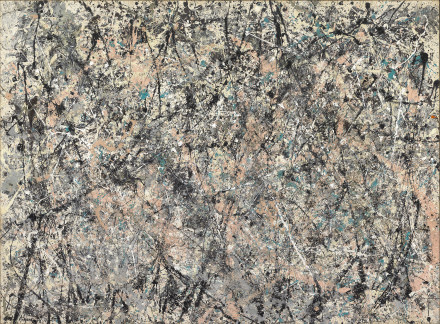
So now, I've moved from scholar to participant in a way, by letting the audience know of my personal associations with Cage and Wolff. I only met Morton Feldman once, at Darmstadt in 1986 and he died, way too young, the following year. The only composer in the group I never met was Earle Brown and I definitely know less about him than the other three, though I think his work of the four is the most in need of becoming better known. Even Feldman, who liked him least, felt that his work had been appropriated without credit by composers like Berio and Lutoslawski who became better known using some of Brown's original ideas. His music was perhaps the most visually connected to the arts of the time, he was especially interested in the improvisatory "all-over" painting methods of Jackson Pollock, and ever more influenced by the mobiles of Alexander Calder which he used as models for compositions he wrote. 

Jackson Pollock, Number 1, 1950 (Lavender Mist)

Alexander Calder, Yellow Sail (1950)

Brown came late to the group, through Cage's invitation, after meeting in Denver following a Cunningham dance concert, likely for practical reasons: Earle Brown would come to assist Cage in the thankless task of putting together Cage's piece for magnetic tape Williams Mix and his wife at the time, Carolyn Brown would become a lead dancer for the Cunningham Dance Company. The only letter to Brown from Cage predates the couple's coming to New York. Arriving in 1952, as mentioned earlier, Brown was a polarizing figure. Feldman didn't want him to be part of the group, and Brown himself never included Christian Wolff when talking about the group. Cage was the only truly connective tissue holding things together. For someone who once wrote about the composers we now regard as the New York School, "Henry Cowell remarked at the New School, before a concert of works by Christian Wolff, Earle Brown, Morton Feldman and myself, that here were four composers who were getting rid of the glue," (Johnson, p.21) it is interesting to note that in keeping the New York School intact for as long as it did, Cage himself was the "glue."

But let's not linger regarding the personal difficulties of keeping such an enormously talented group of composers in such close contact together long-term. And there are plenty of opportunities during this festival to hear and draw your own conclusions as to the merits of their compositions, not by listening to me talk about them but instead by listening to the music yourselves. What I would like to emphasize here is how Cage continues, in his "History of Experimental Music in the United States" essay from which I quoted, where he writes "where people had felt the necessity to stick sounds together to make a continuity, we four felt the opposite necessity to get rid of the glue so that sounds would be themselves."

"Sounds would be themselves." Unfix the continuity, between sounds, between present and past, to seek the newness in what one hears directly. This connects the composers of the New York School to themselves, regardless of their differences which were many, connects them with their great predecessors, which makes them part of the American Experimental Tradition, as described theoretically by Henry Cowell in his great New Musical Resources which all experimental composers, then and now, have read and learned from. Cowell as the great "open sesame" to New Music, which is not the same as the German Neue Musik which wants to separate. No Cowell's New Music wants to connect, to bring together all music that seeks to be new by how it sounds, not by how it is made. It was Cowell who introduced everyone to the music of Charles Ives, was the conduit, at least initially of bringing Edgard Varèse to the attention of composers like Cage and Feldman even more so. And Varèse, as well as Stefan Wolpe (teacher of Feldman and Tudor) who, like Cage and Feldman attended the Artist Club meetings where visual artists regularly gave talks in the early 50s, as they themselves did, provide the European connection that wants to be inclusive. In fact Cage once said that if artists hadn't come to his concerts, the halls would have been empty. Painters and composers in the same room, connected by the one thing they share: being an artist in the larger, more inclusive sense. As Morton Feldman once said about Cage, the real question is, "Is music an art form? For that is what John Cage is forcing us to decide." To these composers, and those of us influenced by them, the answer is yes.

.............................................................................................................................................

This inclusive world, which whether conservatives here and everywhere like it or not, is perhaps more than anything how the sensibility of the New York School, it's predecessors and successors, influences our present day most. Inclusiveness about sounds, how they are made, who makes them, how they are heard and who hears them, when we think this way it is primarily about openness, which for me at least is grounded in listening. John Cage all the way back when he was a teenager wrote an essay later published in a collection of his writings, about our relation to our Mexican neighbor called "Other People Think", something as relevant and maybe more so now than then and what he said was this: "they don't think like we do." And how to you respond to that? You listen. For me, the great legacy of the New York School, as well as the American Experimental Tradition of which it is part, is that: listening. The composers and performers who I have met, many of whom write and perform differently from me and from each other, if they see themselves as experimental like I do, it comes from listening as primary--aural perception more central than conception.

I've always thought the legacy of the New York School specifically and more generally of the experimental tradition can be thought favoring means versus ends. The means or process as it has often been called, nowadays is often through improvisation, Malcolm Goldstein, headliner for this festival, has been one of the pioneers of this in my opinion, and I also think of Pauline Oliveros who is as well, frequently aided with electronics. And these two combined, live in the moment improvisation with electronics, is where I frequently hear the most interesting experimental music today. I also think Child of Tree is a great example of how Cage embraces both electronics and improvisation, which he used to dislike, by removing what he called one's "taste and memory." Now this is a loaded subject and composer/historian George Lewis has rightly questioned this as a way of erasing memories essential to cultural experiences. But we need not decide for or against what Cage desires and what Lewis criticizes, not anyway if we follow the path of inclusiveness that I find essential to the experimental tradition, which Cage and Lewis both share. Stefan Wolpe, who is also seen by some to be tangentially part of the New York School, I alluded to this earlier, once said "Good is to know not to know how much one is knowing." Or as art historian Dore Ashton once wrote regarding the Abstract Expressionists, "the unknown is of higher value than the known." For Cage, Child of Tree offers one the opportunity of improvising in the context of "not knowing."

The means can also include, as it does for me, location: in other words where you are listening not just what you hear. For me, this happens during long walks and my piano preludes were written during very long walks in the New Mexico wilderness and the Pennsylvania woods. You can read about this in the program notes, preferably before the piece is played.

When I first agreed to be part of this festival, I made some off-hand remark to Tom Goldstein about me not being part of the New York School when considering a performance of my music at this festival. Tom being Tom held on to that thought, which I had completely forgotten, and brought it up last week saying he thought my connection was through this relationship I have with nature. There is some truth to take I think, first of all regarding place as I mentioned but also definitely regarding how I listen when I walk in those mountains and woods. Sounds one hears when silent, how I prepare myself to compose and how these preludes came to be written, is remarkably like what one hears when listening to Cage's masterpiece 4'33". I think also this idea of control is important, to "get rid of the glue" in a sense is a willingness to let go, to let those sounds be themselves, to co-exist, as I've often called it, with your materials, or for that matter with the world you live in. A music that comes out of discovery either of sounds heard on a trail, as in Devisadero, or the voices of spirits heard, leading one to a horrifying story of a displaced people as in my World's End Preludes.*

*(I write about this piece in another blog entry: The Making of World's End Preludes)

Morton Feldman once wrote, regarding what he learned from painting, of a "perceptive temperament that waits and observes the inherent mystery of its materials, as opposed to the composer's vested interest in his craft ... the painter achieves mastery by allowing what is being done to be itself. In a way to step aside in order to be in control." (Johnson, p.109)

Stepping aside, that's what I did when I wrote my Preludes, what I do in woods and mountains, why I listen and co-exist with my materials, how I heard those silenced Native American voices in Pennsylvania that then sent me back to New Mexico where I lived with those other voices for decades, and wrote it down. 

John Cage wrote a four channel text piece titled "Where are we going? What are we doing?" that was later published in Silence. The idea was that if you had all four voices going at once you wouldn't be able to pick up everything that was said and would instead pick out what you could hear and the experience would be determined by listener rather than writer. When we programmed it for the Cage retrospective in 1988 something had radically changed: you could hear all voices at once and the piece became a totality that could be completely understood. For that reason I take a different view regarding history, holding on to memories myself, experiencing the past not as something learned but, during those long walks of mine, something that can be discovered or perhaps a better word in this context, revealed. Those seem like Cage's "whispered truths to me," and remind me of Thoreau in the Maine Woods, lost probably, frightened certainly, as he found himself above the treeline on Mount Katahdin, where he famously exclaimed, possibly with a sense of panic but that now I believe can be seen as both a question as well as a way of being in the world: "Contact! Contact! Who are we? Where are we?" Let's say this at least, I see it as my way of being in the world, in contact: trying to stay in contact with the shifting sands ever present, above the New Mexico tree line experiencing the fearsome power of nature or in the deep woods of Pennsylvania, lost, trying to find your way, all the while asking "who are we?" and "where are we?"

------------------------------------------------------------------------------------------------------------------------

(Here is the premiere performance of Devisadero by Curt Cacioppo (John Donald Robb Composers' Symposium, Albuquerque, New Mexico 2008) who performed the complete Preludes for solo piano after I read, due to time constraints, a shortened version of this lecture) :